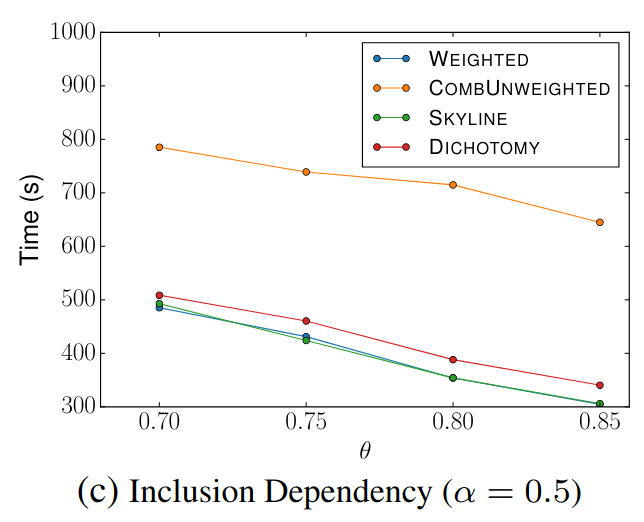
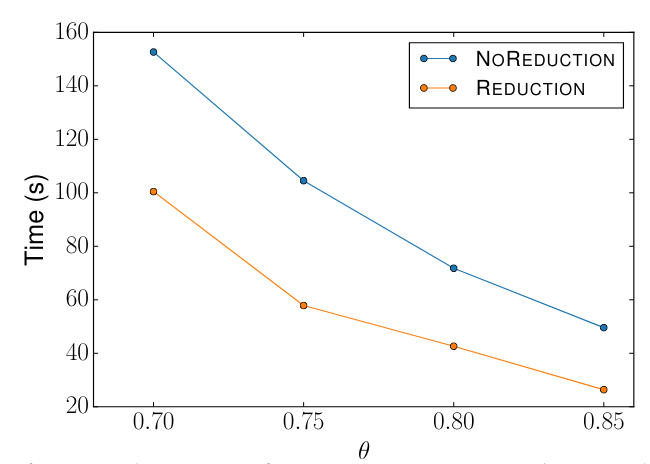
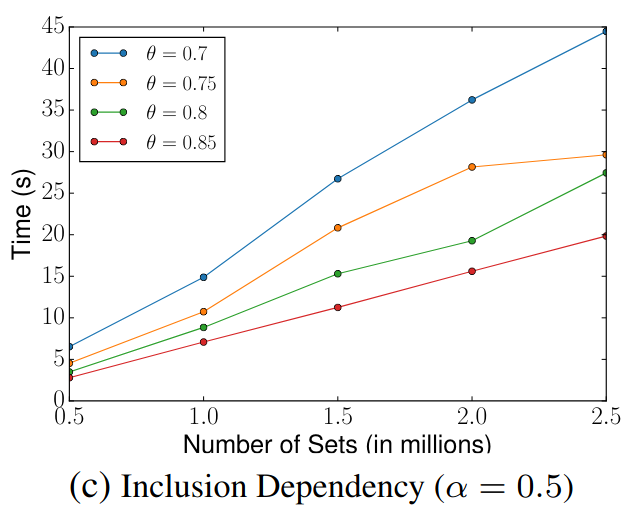
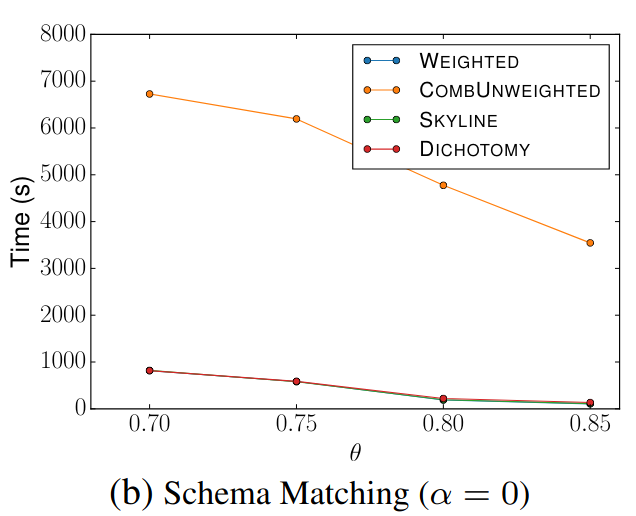
### 🧪 Running the Experiments This project includes multiple experiments to evaluate the performance and accuracy of our Python implementation of **SilkMoth**. --- #### 📊 1. Experiment Types You can replicate and customize the following types of experiments using different configurations (e.g., filters, signature strategies, reduction techniques): - **String Matching (DBLP Publication Titles)** - **Schema Matching (WebTables)** - **Inclusion Dependency Discovery (WebTable Columns)** Exact descriptions can be found in the official paper. --- #### 📦 2. WebSchema Inclusion Dependency Setup To run the **WebSchema + Inclusion Dependency** experiments: 1. Download the pre-extracted dataset from [📥 this link](https://tubcloud.tu-berlin.de/s/D4ngEfdn3cJ3pxF). 2. Place the `.json` files in the `data/webtables/` directory *(create the folder if it does not exist)*. --- #### 🚀 3. Running the Experiments To execute the core experiments from the paper: ```bash python run.py ``` ### 📈 4. Results Overview We compared our results with those presented in the original SilkMoth paper. Although exact reproduction is not possible due to language differences (Python vs C++) and dataset variations, overall **performance trends align well**. All the results can be found in the folder `results`. The **left** diagrams are from the paper and the **right** are ours. > 💡 *Recent performance enhancements leverage `scipy`’s C-accelerated matching, replacing the original `networkx`-based approach. > Unless otherwise specified, the diagrams shown are generated using the `networkx` implementation.* --- ### 🔍 Inclusion Dependency > **Goal**: Check if each reference set is contained within source sets. **Filter Comparison**

Our Result Original Result

**Signature Comparison**

Our Result Original Result

**Reduction Comparison**

Our Result Original Result

**Scalability**

Our Result Original Result

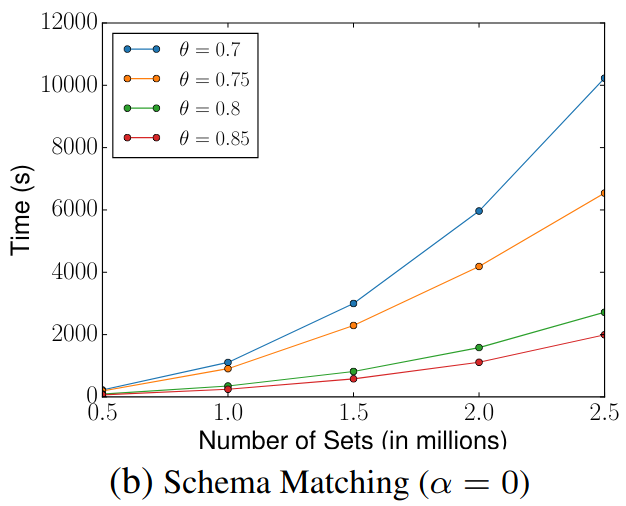
--- ### 🔍 Schema Matching (WebTables) > **Goal**: Detect related set pairs within a single source set. **Filter Comparison**

Our Result Original Result

**Signature Comparison**

Our Result Original Result

**Scalability**

Our Result Original Result

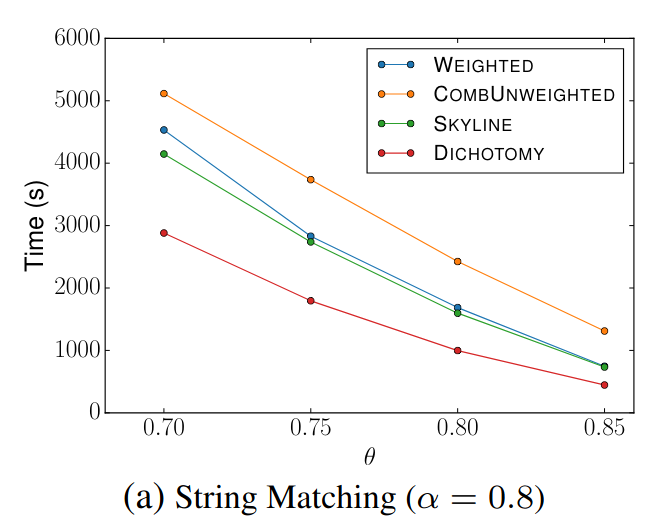
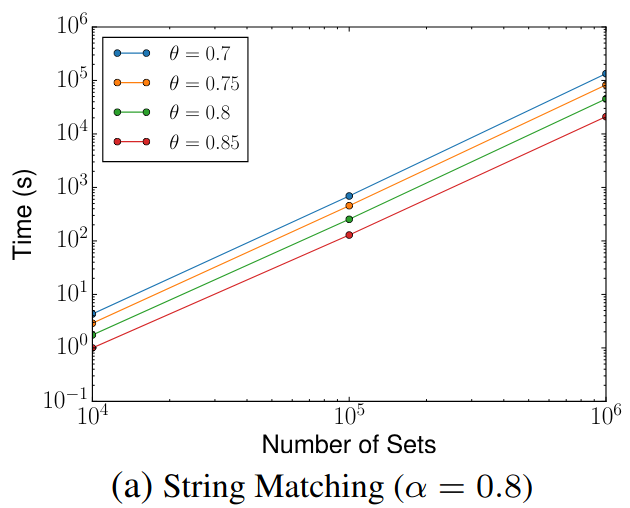
--- ### 🔍 String Matching (DBLP Publication Titles) >**Goal:** Detect related titles within the dataset using the extended SilkMoth pipeline based on **edit similarity** and **q-gram** tokenization. > SciPy was used here. **Filter Comparison**

Our Result Original Result

**Signature Comparison**

Our Result Original Result

**Scalability**

Our Result Original Result

--- ### 🔍 Additional: Inclusion Dependency SilkMoth Filter compared with no SilkMoth > In this analysis, we focus exclusively on SilkMoth. But how does it compare to a > brute-force approach that skips the SilkMoth pipeline entirely? The graph below > shows the Filter run alongside the brute-force bipartite matching method without any > optimization pipeline. The results clearly demonstrate a dramatic improvement > in runtime efficiency when using SilkMoth. WebTables Result --- ### 🔍 Additional: Schema Matching with GitHub WebTables > Similar to Schema Matching, this experiment uses a GitHub WebTable as a fixed reference set and matches it against other sets. The goal is to evaluate SilkMoth’s performance across different domains. **Left:** Matching with one reference set. **Right:** Matching with WebTable Corpus and GitHub WebTable datasets. The results show no significant difference, indicating consistent behavior across varying datasets.

WebTables Result GitHub Table Result